
We get this question quite a bit, and it's usually from somebody in Quincy who just typed "how much can I rent my house for in Quincy, IL" into Google, got a number off Zillow, and wants to know if it's right. Most of the time it isn't, and it's off by more than you'd think. Right now the big rental sites disagree with each other by hundreds of dollars a month on the same kind of house in Quincy, so whichever one you happened to click is more or less a coin flip. Here's why that is and how to get to a number you can actually list at.
Why the number you got online is probably wrong
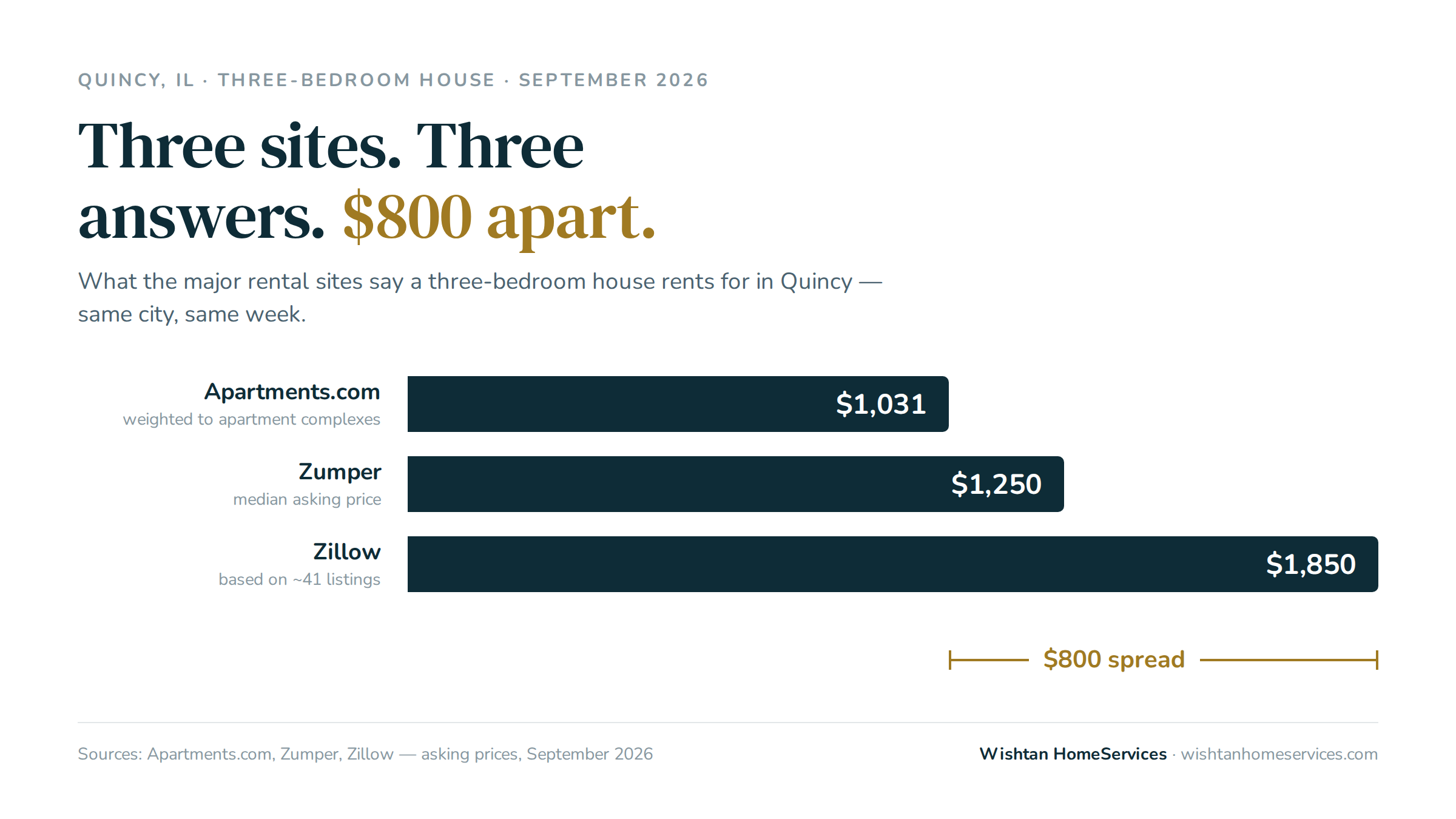
Pull up three different sites for a three-bedroom house in Quincy this month and you get three different answers. Apartments.com says a three-bedroom averages about $1,031. Zumper says the median is $1,250. Zillow says $1,850. That's an $800 spread on the same city in the same week, and none of them are lying, they're just counting different things.
Apartments.com leans heavily on apartment complexes, so its three-bedroom number is mostly units in bigger buildings, not houses with a yard and a garage. Zillow's number comes from whatever's listed on Zillow that week, which in a town our size is only about 40 rentals total, so two or three nice houses on the east side push the whole average up. Zumper lands in the middle for the same reason. None of them know your house has a one-car garage, a basement that takes on water in April, or a brand-new furnace.
The other thing is that these are asking prices, not what somebody actually signed for. In a small market like Quincy, a house listed at $1,500 that sits for two months and gets dropped to $1,300 still shows up in the data at $1,500 the whole time it was sitting.
What actually sets rent on a Quincy house
After hundreds of leases around here, these are the things that move the number, roughly in order of how much they matter:
- Bedrooms and bathrooms. A three-bedroom, two-bath house is a different product from a three-bedroom, one-bath, and in Quincy the second bathroom is usually worth $100 to $150 a month by itself.
- Where it sits. The newer subdivisions on the east side out past 36th Street rent higher than the older houses west of 12th, even at the same square footage, because that's where people moving in for jobs at Blessing, Quincy Medical Group or Knapheide are looking first.
- Condition of the stuff people can see. Flooring, kitchen counters, the bathroom, and paint. A tenant walking through doesn't care that the water heater is new, but they care a lot about carpet that smells like a dog.
- Garage, basement, and laundry. A garage in Quincy matters more than people think because of winter. A dry basement with a washer and dryer hookup is another bump. A wet basement is a subtraction, and tenants can smell it.
- Central air. Older houses in Quincy that only have window units rent for noticeably less in the summer, and they sit longer in July and August.
- Who pays utilities. If the tenant pays gas, electric, water, sewer and trash, the rent can be lower than a house where you cover water and trash. Tenants add it up.
Notice that "what my mortgage is" isn't on that list. The market doesn't know or care what you owe. Pricing a house to cover your payment instead of pricing it to the market is the most common way we see a house sit empty for three months.
How we actually come up with a number
When somebody in Quincy asks us what their house will rent for, this is what happens. We pull every comparable rental in town from the last 90 days, not just what's listed today but what actually leased and how long it took. If we already manage the house, we've walked through it and we know exactly what condition it's in. If we don't manage it yet, we ballpark it off your photos, the neighborhood, and the beds, baths and square footage, then match that condition against the comps so we're comparing apples to apples. Then we pick a number that will get it leased in about two to three weeks with a good applicant, not the highest number we could possibly ask.
That last part is on purpose. Say the comps say $1,250 and you list at $1,400 because Zillow said so. If it sits six extra weeks, you gave up about $1,900 in rent to chase an extra $150 a month, and you won't make that back for over a year. If it sits three months, you've lost more than the entire difference for the whole lease. We run into this every month, and the owners who listen on price end up ahead every time.
The flip side is also true. Underpricing by $100 a month to fill it fast costs $1,200 a year, and you're stuck with it, because rent can't be raised in the middle of a lease. Whatever number you sign at is the number until that lease ends.
A quick way to check your number yourself
If you'd rather do this yourself, here's what I'd do. Go to Zillow and Facebook Marketplace and look at every house for rent in Quincy with the same number of bedrooms as yours. Ignore the ones that have been listed more than 30 days, since those are priced wrong. Sort what's left by condition, be honest about where yours falls, and price it in the middle of that group, not the top. Then watch it. If you don't have five or six serious inquiries in the first week, drop it $50 and keep going.
If that's working for you, keep doing it. I'm not going to try to sell you on something you don't need. The reason people end up calling us is usually not the pricing part, it's that the showings happen at 6 p.m. on a Tuesday and they've got a job and kids, or the house has been sitting and they don't know why.
What the rent means for the rest of the math
Once you've got a realistic number, the rest of the decision gets easy. Take the rent, subtract the mortgage, taxes and insurance, and set aside roughly 8% to 10% for repairs and another month's rent a year for turnover. If that number is positive, you've got a rental. If it's negative or close to zero, you're still probably better off holding it in Quincy than selling into a slow market, but you should go in knowing that instead of finding out in February when the furnace quits.
If you want a number on your actual house instead of an average, we'll pull the comps and walk through it with you for free, no strings. Give us a call at (217) 592-9400 or request a free rental analysis and we'll tell you straight what it'll rent for and how long it should take.